KanbanWP is a free WordPress kanban plugin that puts kanban boards inside your admin area. You create a board, split it into stages, add tasks and drag them forward as work progresses. Board data is stored in your own WordPress database. Your team signs in with WordPress accounts and pays no per-user fee.
This post covers what the plugin does, who it suits, and how to try it.
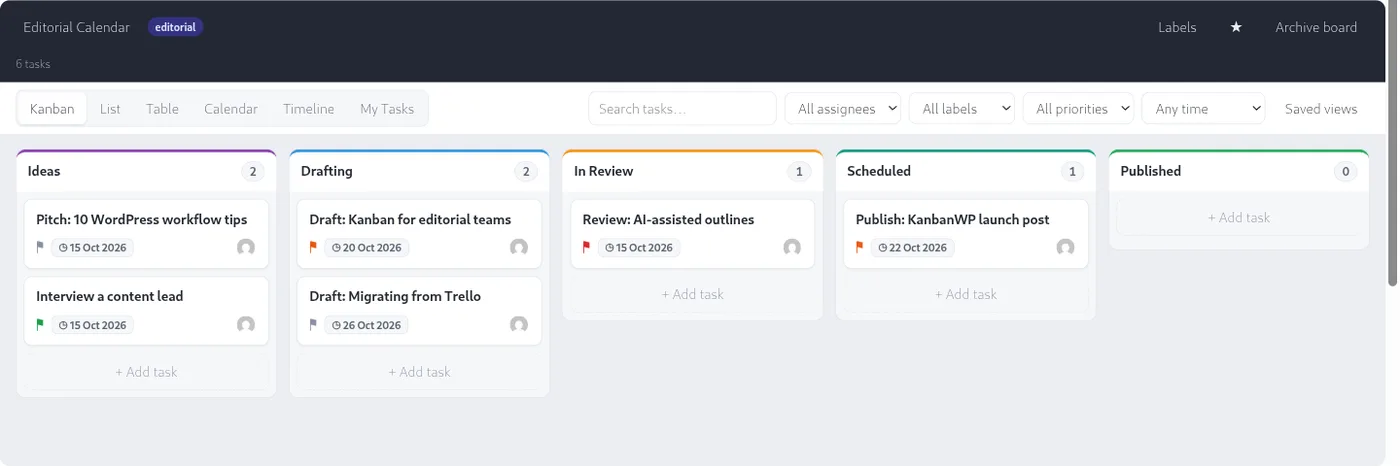
What a kanban board in WordPress does
A board is a set of stages, such as Ideas, Drafting, In Review, Scheduled and Published. Each task is a card that sits in one stage, and you drag the card to the next stage when its status changes. Anyone who opens the board can see what is waiting, what is in progress and what is done.
KanbanWP adds these features to each board:
- Priorities, due dates, assignees and labels on every task.
- Checklists, attachments, custom fields, subtasks and dependencies.
- Recurring tasks that repeat on a schedule.
- Work-in-progress (WIP) limits on stages, which mark a column when it holds too many tasks.
- Swimlanes and saved views to split a busy board.
- Five board templates: Editorial, Client, Sales, Bugs and Blank.
- Comments with @mentions, plus internal-only tasks and comments.
The same tasks also appear in List, Table, Calendar, Timeline and My Tasks views. The documentation covers each area, starting with understanding the kanban board.
Who the plugin is for
KanbanWP suits people who already work in WordPress:
- Editorial teams that track posts from idea to published. A card can link to a WordPress post or page.
- Freelancers and agencies that show clients progress without giving them full access. A client role sees only the boards and tasks you share, and internal items stay hidden.
- Small teams that run a sales pipeline, a bug list or a content calendar.
- Store owners on WooCommerce, who can have new orders and new products added to a board as tasks.
KanbanWP is not built for portfolio planning across a large organization, or for engineering teams that need sprint analytics.
How a WordPress kanban plugin differs from a hosted board
Hosted tools such as Trello and Asana run on the vendor’s servers and charge per user above their free limits. KanbanWP runs on your own site instead.
That changes a few things:
- Accounts: people sign in with their WordPress accounts, and each person gets a board role of admin, member, viewer or client.
- Data: boards, tasks, comments and activity are stored in your WordPress database. You can export any board as JSON.
- Cost: the plugin is free for any number of users. You pay for hosting you already run.
- Responsibility: you handle hosting, backups and updates.
For a full comparison with Trello, read KanbanWP vs Trello.
AI on your own key, and MCP for agents
KanbanWP’s AI features run on your own API key from OpenAI, Anthropic, Google Gemini or an OpenAI-compatible service. Nothing is bundled, and you pay your provider directly. Admins can set a monthly token cap per user and choose which WordPress roles may use AI, and every request is logged.
The AI features include turning pasted notes into tasks, breaking a task into subtasks, summarizing a board, drafting a post outline and writing a client update that leaves out internal work. In version 1.0.1, these features are reached through the REST API.
An MCP (Model Context Protocol) server lets AI agents such as Claude work with your boards, using a token you generate. Agents can list boards, read tasks, create, update and move tasks, and add comments, and each call is written to the activity log. Read bring your own AI key and AI agents and MCP for WordPress boards for details.
Tools for developers
For automation, KanbanWP includes a REST API, WP-CLI commands for boards, tasks, import and export, and outgoing webhooks. Webhooks fire when a task is created, updated, moved or deleted, when a comment is added and when a board is created. Form plugins can create tasks through a kanbanwp_form_submission action. The developer documentation lists the endpoints and hooks.
Getting started
To install the plugin, upload it or install it from the Plugins screen, activate it, and go to KanbanWP, then Boards, in the admin menu. The installation guide and your first board cover each step.
A short trial shows whether the plugin fits:
- Create a board from the template whose stages are closest to how your team works.
- Add a few real tasks, with due dates and assignees.
- Drag the tasks between stages as the work moves.
- Set a default WIP limit in Settings and watch which stage goes over it.
If you are comparing tools first, read best Trello alternatives in 2027. KanbanWP is a new plugin under new ownership, and the About us page explains who builds it.
Frequently asked questions
Is KanbanWP free?
Yes. KanbanWP is licensed under the GPLv2 or later, with no license key, paid tier or per-user fee. AI features use your own provider key, so you pay the provider for the tokens you use.
Where does KanbanWP store board data?
Boards, tasks, comments and activity are stored in tables in your own WordPress database. The plugin sends data out only to services you configure, such as an AI provider or a Slack webhook.
What does KanbanWP need to run?
KanbanWP needs WordPress 5.8 or later and PHP 7.4 or later. Version 1.0.1 is tested up to WordPress 6.8.