A kanban board is a visual board that shows each piece of work as a card, placed in a column for the step it is at. Cards move from left to right as the work progresses, and a work-in-progress (WIP) limit caps how many cards each busy column should hold. This page answers “what is a kanban board?” and explains what a board is made of, where the kanban system came from, the principles and practices of the Kanban Method, and the kanban metrics that show whether work is flowing.
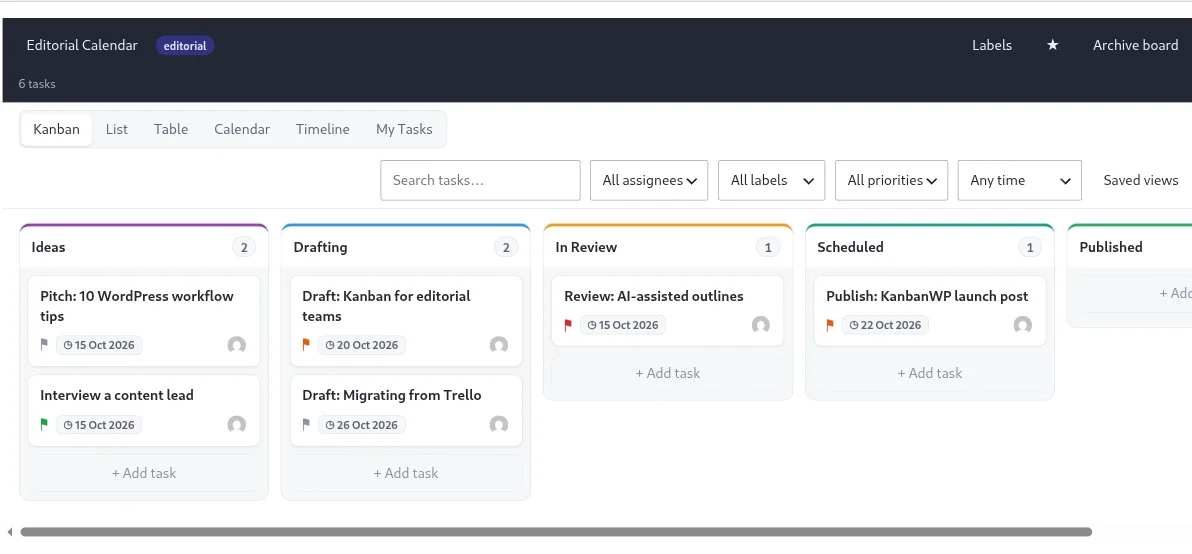
What is a kanban board?
A kanban board turns a process into columns and a list of work into cards. When you look at it, you can see what is being worked on, what is waiting and what is finished, without asking anyone. The word kanban is Japanese for a sign or card, which is why each item on the board is called a card.
Most boards start with three columns: To Do, Doing and Done. Teams then add the steps their work goes through, such as Review or Waiting on client. Boards can be physical, with sticky notes on a wall, or digital, inside software that a remote team can open from anywhere.
The parts of a kanban board
A kanban board has these parts:
- Cards. One card is one piece of work, such as an article, a bug or a sales lead. The card shows its title and a few details, such as who owns it and when it is due.
- Columns. Each column is one step in the process. KanbanWP calls columns “stages”.
- WIP limits. A WIP limit is the most cards a column should hold at once. It stops a team from starting more work than it can finish.
- A commitment point. This is the place where an idea becomes work the team has agreed to do, often the move from Backlog to the first active column.
- A delivery point. This is the place where work leaves the system as finished, such as Published or Done.
- Swimlanes. These optional horizontal rows split the board by team, client or type of work, while every row keeps the same columns.
The Kanban University guide says a kanban system needs “at least one clear commitment and delivery point as well as a representation of the permitted amount of work.” In other words, a board with columns but no limits and no clear start and end points is a task list in columns.
Where the kanban system came from
Kanban started in car manufacturing. Toyota’s official 75-year history says the company introduced a “supermarket method” in 1954, based on a report about a Lockheed aircraft plant in the United States. Each later process took parts from the process before it, the way a shopper takes goods from a shelf.
That method grew into the Kanban System when Toyota added a production instruction sheet called the kanban. The card or board showed the product name, product number and quantity. The system then developed into Just-in-Time, which Toyota describes as “producing only what is needed, when it is needed, and in the amount needed.”
Toyota credits Taiichi Ohno with building the foundation of its approach to making things. The Kanban Guide traces today’s kanban to the Toyota Production System and to the work of Ohno and W. Edwards Deming.
Kanban reached knowledge work much later. The Kanban Guide says the practices for knowledge work “mainly originated on a team at Corbis in 2006.” David J. Anderson described them in his 2010 book Kanban: Successful Evolutionary Change for Your Technology Business, which Kanban University names as the basis of the Kanban Method.
The Kanban Method: principles and practices
Two guides describe kanban for knowledge work today, and they use different words for similar ideas.
- The Official Guide to The Kanban Method, from Kanban University, follows Anderson’s method. It lists principles and six general practices.
- The Kanban Guide, at kanbanguides.org, is written by Daniel Vacanti, John Coleman and other contributors. Version 2025.5 defines kanban as “a strategy for optimizing the flow of value through a process” and lists three practices.
Kanban principles
Kanban University lists three change management principles:
- Start with what you do now.
- Agree to pursue improvement through evolutionary change.
- Encourage acts of leadership at all levels.
It also lists three service delivery principles:
- Understand and focus on customer needs and expectations.
- Manage the work, and let people self-organize around it.
- Regularly review the network of services and its policies in order to improve outcomes.
The first principle matters most when you begin. You do not rename roles or reorganize the team. You draw the process you already follow and improve it in small steps.
The six general practices
Kanban University’s six practices are:
- Visualize. Put the work and the process on a board.
- Limit work in progress. The guide says WIP limits balance utilization with flow, and that they reduce delay and context switching.
- Manage flow. Aim to finish work as smoothly and predictably as possible at a sustainable pace.
- Make policies explicit. Write down the rules, such as when a card counts as finished and who pulls new work.
- Implement feedback loops. Hold regular meetings and reviews, which the guide calls cadences.
- Improve collaboratively, evolve experimentally. Change the process in small experiments and keep what works.
The Kanban Guide’s three practices
The Kanban Guide groups the work into three practices: defining and visualizing a workflow, actively managing items in a workflow, and improving a workflow. Its “Definition of Workflow” asks a team to agree on what a work item is, when work counts as started and finished, the states in between, how WIP is controlled, explicit policies for each state, and a service level expectation, which is a forecast of how long an item should take.
Kanban board vs kanban system
The board is the part of a kanban system you can see. The system also includes the WIP limits, the written rules for moving cards and the regular meetings where the team looks at the board together. Two teams can draw the same columns and run very different systems, because one team agrees on the rules and the other does not.
Much of what makes a system work never appears as a card. What isn’t on the board covers that invisible work and how to write explicit policies.
Kanban metrics
Kanban metrics tell you whether work flows or piles up. The Kanban Guide names four measures:
- Work in progress (WIP): “The number of work items started but not finished.”
- Throughput: “The number of work items finished per unit of time.”
- Work item age: “The elapsed time between when a work item started and the current date.”
- Cycle time: “The elapsed time between when a work item started and when a work item finished.”
Kanban University uses related terms. Lead time runs from the commitment point to completion, delivery rate counts finished items per unit of time, and a cumulative flow diagram shows how many items sat in each step on each day.
These measures are linked by Little’s Law, a queuing result that John D. C. Little proved in 1961 and reviewed in 2011. Over a stable period, average WIP equals throughput multiplied by average cycle time. If throughput stays the same and WIP goes up, the average item takes longer to finish, which is the reason kanban limits WIP.
What KanbanWP shows
Each stage header in KanbanWP shows its card count, and when the stage has a limit it shows the count against the limit, such as 3/5. Above the limit, the count changes to a warning style and an “over WIP limit” badge appears. The warning does not block anyone from moving a card. See WIP limits.
The Reports screen shows, for one board:
- the number of tasks in each stage,
- tasks completed in the last seven days,
- average cycle time in days, measured from when a task is created to when it is completed,
- a cumulative flow chart for the last 30 days.
KanbanWP’s cycle time starts when a task is created, not when work starts. It therefore includes time spent waiting in the backlog, so it is closer to lead time than to the Kanban Guide’s cycle time.
Kanban vs Scrum
Scrum and kanban are often compared. The 2020 Scrum Guide sets work in Sprints, which are “fixed length events of one month or less,” and names three accountabilities: the Developers, the Product Owner and the Scrum Master.
Kanban has no fixed iterations and no required roles. Work enters the board when there is capacity for it, and the WIP limits decide when that is. Some teams use a kanban board inside Scrum Sprints, and the two approaches do not exclude each other. For a full comparison, including Scrum boards and Scrumban, see kanban vs Scrum.
Common mistakes with a new kanban board
- Too many columns. Each column is another place for work to wait. Three to five is enough to start.
- No WIP limits. Without limits, nothing tells the team to finish before starting.
- Columns named after people. A column called “Sam” shows workload, not process. Use swimlanes or assignees for people.
- Cards that are too big. A card that sits in one column for weeks hides its progress. Split it into smaller cards or subtasks.
- A board nobody updates. The board has value only if the team agrees it is the source of truth.
Start a kanban board in WordPress
KanbanWP is a free WordPress plugin that keeps boards in your own WordPress database. To try kanban on one real project:
- Install KanbanWP.
- In KanbanWP > Settings, set a Default WIP limit, so the stages of your new board start with a limit.
- Create a board from one of the five kanban board templates.
- Put this week’s real work on it and watch which stage fills up first.
Understanding the kanban board explains the screen. For the case for and against kanban, read the benefits of kanban. For boards outside software, see these kanban examples. For ready setups, see project management, the editorial calendar and the sales pipeline.
Frequently asked questions
What is a kanban board?
A kanban board is a visual board that shows each piece of work as a card in a column, with one column for each step of your process. Cards move from left to right as work progresses, and work-in-progress limits cap how many cards a column should hold.
What is the difference between a kanban board and a kanban system?
The board is the part you can see. A kanban system also includes the agreements behind it, such as WIP limits, the rules for moving cards and the regular meetings where the team reviews the work.
What are the kanban principles?
Kanban University lists three change management principles: start with what you do now, agree to pursue improvement through evolutionary change, and encourage acts of leadership at all levels. It also lists three service delivery principles about customer needs, self-organization and regular review.
What are the main kanban metrics?
The Kanban Guide names four: work in progress (WIP), throughput, work item age and cycle time. Kanban University also uses lead time, delivery rate and the cumulative flow diagram.
Where did kanban come from?
Kanban comes from Toyota's production system, where a kanban card told a process which part to make and how many. David J. Anderson's 2010 book adapted the idea for knowledge work as the Kanban Method.